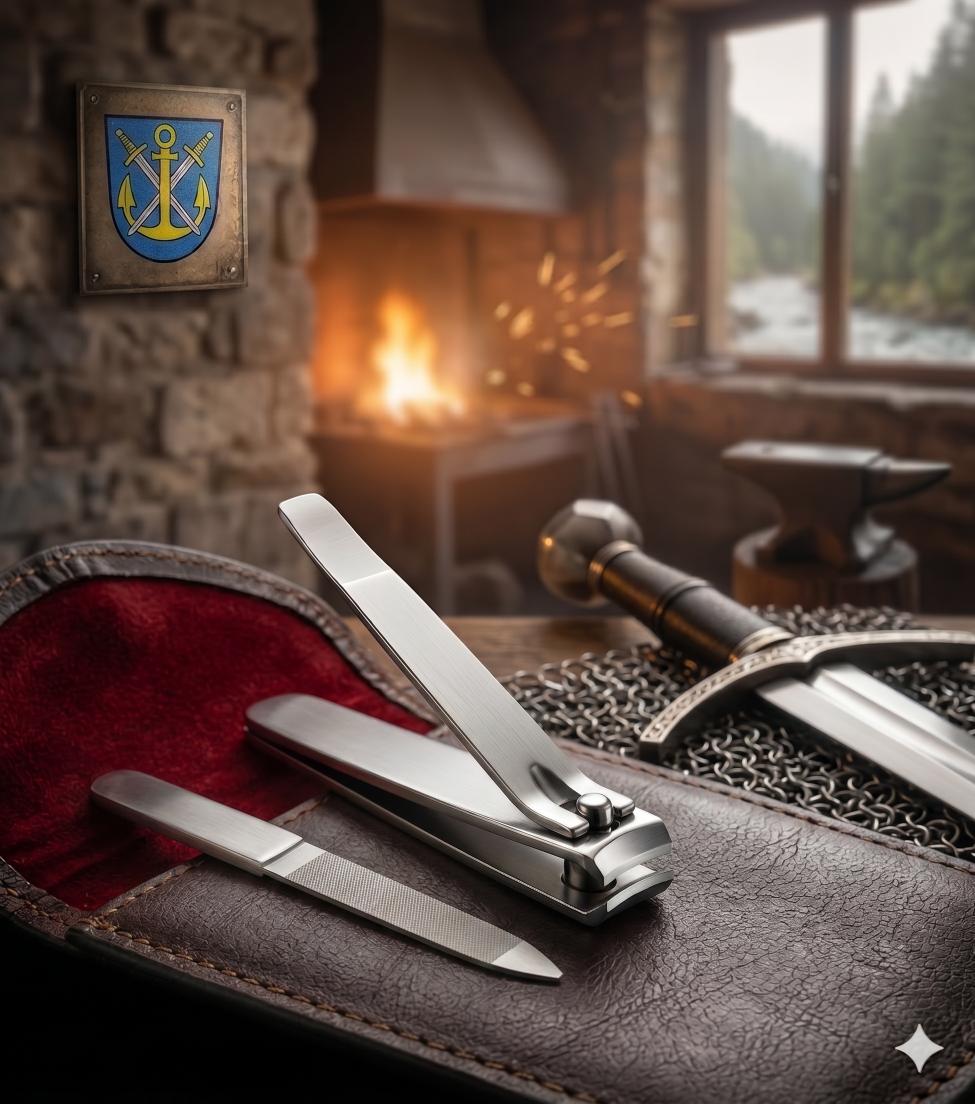
The History of the 'City of Blades'
If you look closely at the world's most elite cutlery and precision instruments, you will often find a common thread leading back to a single region in North Rhine-Westphalia. For over 800 years, the German city of Solingen has been synonymous with one thing: the relentless pursuit of the perfect edge.
Known globally as the "City of Blades," this region established the worldwide standard for metallurgical excellence. But how did a medieval forging hub transition into the inspiration for modern, master-level grooming tools?
The History of the 'City of Blades'
Solingen's dominance in metallurgy was not an accident; it was a product of geography. The city is surrounded by dense forests (which provided endless timber for charcoal) and fast-flowing rivers (which powered the massive grinding wheels). By the Middle Ages, the blacksmiths of Solingen were legendary.
In the 13th and 14th centuries, the demand was for survival and conquest. Solingen workshops forged the swords, rapiers, and armour used by monarchs and knights across Europe. The steel had to be uncompromising—a brittle blade or a dulled edge on the battlefield was a matter of life and death. This high-stakes environment forged a culture of strict quality control and generational craftsmanship.
From the Battlefield to the Bathroom Cabinet
As the centuries progressed and the era of the sword faded, the master smiths of the region had to adapt. People no longer needed broadswords for daily life, but they still required exceptionally sharp, durable blades.
The very same tempering techniques and high-carbon alloys that once created indestructible weaponry were redirected into precision instruments. The focus shifted from swords and daggers to surgical scalpels, tailor's shears, and eventually, premium personal care tools. The blacksmiths realised that the exact same principles of tension, balance, and edge retention applied just as much to cutting a cuticle cleanly as they did to outfitting an army.
What Makes German-Inspired Metallurgy Superior?
The secret behind this historical standard lies in the material and the thermal treatment. Premium German-style blades typically utilise high-carbon stainless steel.
While standard high street clippers use soft, cheap metals that crush rather than cut, high-carbon steel is exceptionally dense. When heated to extreme temperatures (often exceeding 1000°C) and rapidly cooled, the molecular structure of the metal changes. This allows the blade to take an incredibly fine edge and, more importantly, hold that edge for years without dulling or rusting.
The Scharfmeister Philosophy: Inspired by the Standard
It is this exact heritage of uncompromising engineering that inspired the foundation of Scharfmeister. We reject the throwaway culture of the modern personal care market, where disposable tools are the norm.
We set out to capture the philosophy of traditional European metallurgy and apply it to the modern grooming ritual. By utilising premium high-carbon stainless steel, our instruments are engineered to maintain a master-level calibration far longer than cheap alternatives.
While modern technology ensures perfect geometric consistency in our tools, the critical elements—the edge alignment, the tension, and the balance in the hand—are subjected to strict quality control inspired by the world's most exacting craftsmen.
When you hold a Scharfmeister instrument, housed in its premium engineered leather case, you feel the weight of true material quality. It is not just a tool; it is an investment built to endure.
Explore the uncompromising precision of The Scharfmeister Collections today.